The Transformation of Democracy by Robert Kelley
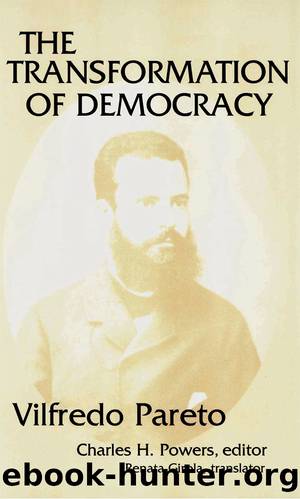
Author:Robert Kelley [Kelley, Robert]
Language: eng
Format: epub
Tags: Democracy, Political Science, General, Political Ideologies
ISBN: 9781351302425
Google: jJcuDwAAQBAJ
Goodreads: 35864531
Publisher: Routledge
Published: 2017-07-28T00:00:00+00:00
Notes
This paper was originally published in two parts, on May 20 and June 5, 1920, in Rivista di Milano.
1. In Roman law, precarium is the free concession of an object on the condition that it will be returned on demand by the grantor.[Ed.]
2. All quotations comments inside of brackets are those of Pareto.[Ed.]
3. Antonio Pertile, Storia del diritto italiano, Volume 1. [Ed.âA number of Paretoâs references are incomplete and are presented as they appeared in the original manuscript.]
4. Sidney and Beatrice Webb, The History of Trade Unionism (New York: Longmans, Green, 1894).
5. Agostino Lanzillo, La Disfatta del socialismo (Florence: Libreria della Voce) pp. 270, 277.
6. Pagine libere (Milan, February 15, 1920), p. 2.
7. âThe bourgeoisie must convince itself that it reaps the fruits of a crazy and suicidal policy perpetrated during five years of war. It lied to the people in order to encourage national âresistance.â Resist! The bourgeoisie was under the illusion that it could obtain the support of the people and the armed forces by making chimerical promises it never intended to keep. Now it is hanging by the neck from its own lies.â Resto del Carlino (March 7, 1920).
8. âSaracenâ was a term used in reference to Muslims during the Middle Ages.[Ed.]
9. Capitulare primum anni DCCCII sive capitula data Missis Dominicis, anno secundo imperil Cap. I.
10. Capitularium Karoli Magni . . . lib. II. cap. XXVI.
11. Fustel de Coulanges, Nouvelles Recherches sur quelques problèmes dâhistoire (Paris, 1891).
12. On another occasion Fustel de Coulanges was led by his own observations to the conclusions I have drawn regarding the relationship between thoughts and action. He discusses opposition between Austrasia and Neustria. [Austrasia was the Eastern Territory of the Franks under the Merovingian kings. It included Belgium, Lorraine, and portions of the valley of the Rhine. Neustria was the Western Territory, extending from the Meuse River to the Loire River.] âMoreover, let us not suppose that these men draw their inspiration from a political doctrine or from a pure idea. There are interests and even desires which move each one of them.â (Les Transformations de la royante pendant lâépoque Carolingienne, Paris, 1914). One could say the same thing about contemporary unions. If one discounts a few people with their imaginative visions, what the masses really want are high wages, short working hours, and greater dignity. They do not have the slightest conception of what the future will really bring.
13. âAt Leghornâs railroad station, railway employees refused to allow the train on which the 231st infantry was traveling to pass. The government gave up and transported the soldiers to Genoa on the battleship Duilio. When they arrived, on the morning of April 10, the powerful metal workersâ shop at Giano pier stopped work and asked that the soldiers not disembark. The strike spread throughout the port when the government refused to assent to this demand. A general strike was called later at the Port of Grazia.â Idea Nazionale (April 21, 1920). The government did not dare to employ force against railway workers and arranged to transport troops to Turin via truck.
Download
This site does not store any files on its server. We only index and link to content provided by other sites. Please contact the content providers to delete copyright contents if any and email us, we'll remove relevant links or contents immediately.
The Secret History by Donna Tartt(19092)
The Social Justice Warrior Handbook by Lisa De Pasquale(12191)
Thirteen Reasons Why by Jay Asher(8912)
This Is How You Lose Her by Junot Diaz(6889)
Weapons of Math Destruction by Cathy O'Neil(6281)
Zero to One by Peter Thiel(5802)
Beartown by Fredrik Backman(5756)
The Myth of the Strong Leader by Archie Brown(5509)
The Fire Next Time by James Baldwin(5447)
How Democracies Die by Steven Levitsky & Daniel Ziblatt(5219)
Promise Me, Dad by Joe Biden(5154)
Stone's Rules by Roger Stone(5088)
A Higher Loyalty: Truth, Lies, and Leadership by James Comey(4964)
100 Deadly Skills by Clint Emerson(4927)
Rise and Kill First by Ronen Bergman(4790)
Secrecy World by Jake Bernstein(4753)
The David Icke Guide to the Global Conspiracy (and how to end it) by David Icke(4720)
The Farm by Tom Rob Smith(4514)
The Doomsday Machine by Daniel Ellsberg(4490)
